Now that SP and BSP have announced their pre-poll alliance for Lok Sabha 2019 election, let's look at the numbers. Let's look at constituencies where BJP won but SP + BPS got a larger vote share. So with this unlikely assumption that all the vote is transferrable, what would be the impact of these parties coming together. Following is the list of constituencies where SP + BSP scored more than BJP in the last election.
So, there are 36 constituencies where SP + BSP had polled more vote than BJP in last election. Since we are doing this hypothetical exercise, let's how the situation changes if we throw INC also in the mix.
So, if we take BSP+SP+INC together, we see that they polled more votes than BJP in last election in 48 constituencies.
Saturday, January 12, 2019

Monday, January 7, 2019
Why I think reservation for poor upper castes is not an effective solution
In my view, the whole point of the reservation is to force decision makers to hire people from a specific grouping. Let's look at OBC or SC/ST reservation. It is widely believed, probably rightly so, that even if qualified candidates were available they will be discriminated again at every level starting from school, college and finally job interviews.
It is not impossible to believe that a brilliant candidate from SC/ST or OBC, when appears in an interview before an interview panel mostly consisting of upper caste individual, they will find some way to not hire him. In my mind, this is the basis of the reservation of these three grouping in jobs.
For upper caste individuals, it can not be believed that discrimination is likely. Also, the limits in income that are placed are high enough (Rs. 8,00,000 pa by some estimates) that most deserving candidates will not be able to compete against other individuals who are well off.
In my view, what is required is to eliminate the imbalance in the opportunity that exists for poor candidates. For example, there is a multitude of coaching institutes that are available for candidates but the fees are so high that the poor can not participate in them. This is what needs to be balanced. Either the examination patterns need to be changed so that coaching institutes become ineffective or government needs to subsidize those people who are in need of these facilities.
When I studied, way back in the eighties, the education was not expensive. My complete engineering education was completed with less than Rs. 1000. Today it costs lakhs of rupees. We need to see education as a means to build human resources and not make it a money-making scheme.
Sunday, December 16, 2018
As I complete 27 years in Industry
This is an edit on top of the blog post that I wrote five years ago when I completed 25 years. The original post is here.
 Today I complete 27 years in the workforce. I started working
for
Joining BEL
I completed my graduation in June-1991 and was asked to join BEL on 16th December 1991 in Bangalore unit. We had three months of training and we were called probationary engineers till our training was completed. Once we completed our training, we were designated Deputy Engineer and posted to our units which in my case was BEL Kotdwara in the foothills of Garhwal mountain ranges.
BEL Kotdwara
I, along with the group of other 5 engineers from thebatch in
Motorola India Electronics Ltd., Bangalore
I joined MIEL on 3rd of October, 1994 in Bangalore at their office on St. Marks Road. The building was called "The Presidency". Since the building was full, after joining and training I was sent to work at a rented facility at Manipal Center at the junction of Dickenson Road and Cubbon Road. Ina few months
Leaving Motorola
In
Entrepreneurship
In July 2010, I joined the startup witha few of my friends, to build a product in the telecommunication infrastructure space. We built a prototype, demonstrated to few tier-1 operators across the world and then we were acquired by Movik Networks in October 2010.
Movik Networks
I joined Movik Networks as part of that acquisition, did some interesting work forthe next few months
In April 2011, I joined Hewlett-Packard in Bangalore.
Hewlett Packard
I worked at HP in the storage group. We built a scale-out file system for large storage systems.The work in place was reasonably good but the politics of the place just got to me. I left in October 2014 after little more than three years in the place.
Oracle
I joined Oracle's cloud group and worked on Application PaaS. I found the company very suffocating for technical people. Even architecture documents were approved by managers there. So finally left the place after little more than one year.
Hubble Connected India Private Limited
Joined the company because they were running a cloud service that required a refresh and needed to berearchitected to run at a much higher scale. We built a brand new service, scaled it from a little over 100,000 subscribers to close to one million subscribers. Finally had a disagreement with the management and left the place.
Tesco
Joined Tesco in January 2018.
To summarize, it has been an interesting ride for the last 27 years. What is the most disappointing is the level of technology ownership in most of the Industry? I had expected that we would see more technology and product ownership with Indianindustry, which does not seem to be the case. Hope things would improve in the next few years.

Joining BEL
I completed my graduation in June-1991 and was asked to join BEL on 16th December 1991 in Bangalore unit. We had three months of training and we were called probationary engineers till our training was completed. Once we completed our training, we were designated Deputy Engineer and posted to our units which in my case was BEL Kotdwara in the foothills of Garhwal mountain ranges.
BEL Kotdwara
I, along with the group of other 5 engineers from the
Motorola India Electronics Ltd., Bangalore
I joined MIEL on 3rd of October, 1994 in Bangalore at their office on St. Marks Road. The building was called "The Presidency". Since the building was full, after joining and training I was sent to work at a rented facility at Manipal Center at the junction of Dickenson Road and Cubbon Road. In
Leaving Motorola
Entrepreneurship
In July 2010, I joined the startup with
Movik Networks
I joined Movik Networks as part of that acquisition, did some interesting work for
In April 2011, I joined Hewlett-Packard in Bangalore.
Hewlett Packard
I worked at HP in the storage group. We built a scale-out file system for large storage systems.
Oracle
I joined Oracle's cloud group and worked on Application PaaS. I found the company very suffocating for technical people. Even architecture documents were approved by managers there. So finally left the place after little more than one year.
Hubble Connected India Private Limited
Joined the company because they were running a cloud service that required a refresh and needed to be
Tesco
Joined Tesco in January 2018.
To summarize, it has been an interesting ride for the last 27 years. What is the most disappointing is the level of technology ownership in most of the Industry? I had expected that we would see more technology and product ownership with Indian
When I started working 27 years ago, I was of the view that I will not work as an employee for more than 25 years. That is one milestone that I have unfortunately missed. I have not been able to transition from a salaried job to either freelance consulting or build a company of my own. That is probably the biggest regret that I have as I complete 27 years.
Monday, March 26, 2018
Fixing Aadhaar
It is an academic discussion whether any country or society needs something like Aadhaar or not. There are pros and cons of having a single identity system. I am not going into merits or demerits of a system like Aadhaar here. What I want to discuss here are the methods to secure a system like Aadhar.
How should we view the Aadhaar number? The closest equivalence that I can see here is a username to any website. Should the username be secure or not? Making username secure does make it harder for somebody to hack into the account. This is one of the reasons why in case of a failed authentication, we want the developers not to disclose what was wrong, was it username that was wrong? or the password that was wrong?
Another way to look at the Aadhaar number would be a credit card number. The credit card number, on its own, is not sufficient to do any transaction but it is a big piece of the credit card transaction puzzle.
As we have observed in past weeks, there is a case to be made that Aadhaar data center is probably secure but for it to be useful, it has to be connected to the internet. It is this part of the puzzle that completely breaks the Aadhaar architecture.
Aadhaar expects its third-party partners to capture the Aadhaar number and OTP and send it over to UIDAI server for identity verification. This leaves them completely open to misuse by third-party partners. Given that UIDAI has not really shown great foresight in security audit of their partners and has no way to make sure that the partner systems are secure, they really can't depend on their partners (government and private) to secure the system. Any system is as secure as the weakest link in the network. So if a state government has a spreadsheet with Aadhaar details in an open directory all the security of UIDAI data center is just useless. Any malicious user is not going to try to breach the strongest parts of any system, they will go after weakest parts of the system.
I don't really know the details of Aadhaar architecture, but my guess is that at top level following things are happening.

The problem lies in the fact that Aadhaar number is captured by the third party and UIDAI depends on them to handle it properly. To get control over this problem, the best way is to move the capturing of Aadhaar number to the UIDAI server. This problem has been solved in FinTec domain by companies like Visa and Master. The secure information is only captured by UIDAI server and the third-party is just informed of success or failure.

This small modification will at least take the burden of securing Aadhaar system from the hands of third-party. They are only concerned with one information whether the person's identity is verified or not. The persistent verification id can solve that problem.
This does not mean that this makes the system completely secure. A large system like Aadhaar should have their complete source code in public domain so that security researchers can review it and notify changes. Source codes don't implement security, security is implemented by certificates and encryption keys.
How should we view the Aadhaar number? The closest equivalence that I can see here is a username to any website. Should the username be secure or not? Making username secure does make it harder for somebody to hack into the account. This is one of the reasons why in case of a failed authentication, we want the developers not to disclose what was wrong, was it username that was wrong? or the password that was wrong?
Another way to look at the Aadhaar number would be a credit card number. The credit card number, on its own, is not sufficient to do any transaction but it is a big piece of the credit card transaction puzzle.
As we have observed in past weeks, there is a case to be made that Aadhaar data center is probably secure but for it to be useful, it has to be connected to the internet. It is this part of the puzzle that completely breaks the Aadhaar architecture.
Aadhaar expects its third-party partners to capture the Aadhaar number and OTP and send it over to UIDAI server for identity verification. This leaves them completely open to misuse by third-party partners. Given that UIDAI has not really shown great foresight in security audit of their partners and has no way to make sure that the partner systems are secure, they really can't depend on their partners (government and private) to secure the system. Any system is as secure as the weakest link in the network. So if a state government has a spreadsheet with Aadhaar details in an open directory all the security of UIDAI data center is just useless. Any malicious user is not going to try to breach the strongest parts of any system, they will go after weakest parts of the system.
I don't really know the details of Aadhaar architecture, but my guess is that at top level following things are happening.
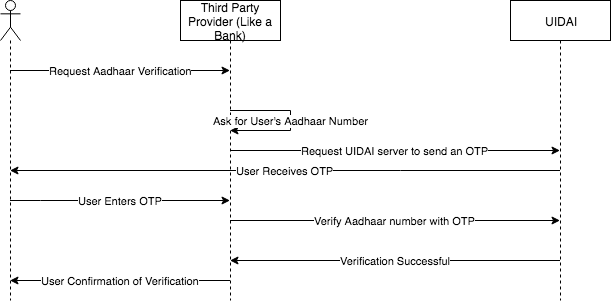
The problem lies in the fact that Aadhaar number is captured by the third party and UIDAI depends on them to handle it properly. To get control over this problem, the best way is to move the capturing of Aadhaar number to the UIDAI server. This problem has been solved in FinTec domain by companies like Visa and Master. The secure information is only captured by UIDAI server and the third-party is just informed of success or failure.

This small modification will at least take the burden of securing Aadhaar system from the hands of third-party. They are only concerned with one information whether the person's identity is verified or not. The persistent verification id can solve that problem.
This does not mean that this makes the system completely secure. A large system like Aadhaar should have their complete source code in public domain so that security researchers can review it and notify changes. Source codes don't implement security, security is implemented by certificates and encryption keys.
Wednesday, March 21, 2018
Why it is the time to leave Facebook
I am not one of those naysayers who believe in completely getting out of Social Media. Social media is a double-edged sword, you are letting go of some of your privacy in return for connectivity that you might not achieve otherwise. When I sign up with a Social Media Platform, I expect them to safeguard my data with some seriousness. It is because of that specific concern, I have decided to single out Facebook here. Facebook seems to have following two specific issues.
All these philosophical arguments aside, in this busy life, one has to look at return on investment on time spend on any activity. When it comes to Facebook, there are absolutely zero returns on time spent on it. It looks more and more likely that my life will be better without Facebook in it.
- As a technology platform, it just seems to be badly designed. Something as fundamental as "friends permission" should not be part of any platform which wants to be a serious player in a business that is primarily about access to ones' personal data. For the uninitiated, friends permission was the feature in the Facebook API where Facebook will share your data with a third party even if you have not explicitly given permission to share this data. If any of your friends have given the permission to share data, your data could also be shared.
- As a company, it is clear that Facebook has very little interest in being on the side of its users. If anytime they need to make a call where they have to forego some revenue to safeguard the privacy of a user, they will lean on the side of revenue.
What is Cambridge Analytics issue
Facebook's friends permission concept was allowing data of people to go to third parties who had not authorized third-party themselves and was relying on terms of service and settings that people didn’t read or understand to safeguard themselves against any legal action. Global Science Research was run by Cambridge University psychologist Aleksandr Kogan who built an app for a personality test for Facebook Users. The app automatically downloaded data from friends of people who took the quiz for academic purposes.
The app had only about a quarter of a million users who took a paid quiz but they were able to download the data for close to 50 million Facebook users by using friends permission feature of the API.
Facebook takes a 30% cut from the revenue of any app in return for allowing access to friends permission.
The I have done nothing wrong argument or I have nothing to hide
This is an argument that I hear from my friends often, why worry if you have done nothing wrong. It automatically means that if you are worried about online privacy, you must have done something wrong.
Daniel J. Solove stated in an article for The Chronicle of Higher Education that he opposes the argument; he stated that a government can leak information about a person and cause damage to that person, or use information about a person to deny access to services even if a person did not actually engage in wrongdoing, and that a government can cause damage to one's personal life through making errors.
Schneier also argued "Too many wrongly characterize the debate as 'security versus privacy.' The real choice is liberty versus control.Closer to home, Supreme Court of India recently said:
Explaining why it is necessary to enshrine right to privacy as a fundamental right as opposed to a statutory right, Justice Rohinton Fali Nariman said, "Statutory law can be made and also unmade by a simple Parliamentary majority. In short, the ruling party can, at will, do away with any or all of the protections contained in the statutes mentioned hereinabove. Fundamental rights, on the other hand, are contained in the Constitution so that there would be rights that the citizens of this country may enjoy despite the governments that they may elect... The recognition of such right in the fundamental rights chapter of the Constitution is only a recognition that such right exists notwithstanding the shifting sands of majority governments."If we agree that privacy is a right, then the burden of proving its utility doesn't lie on me but on the person or entity that wants to infringe on it and frankly, Facebook has not made a very good case.
All these philosophical arguments aside, in this busy life, one has to look at return on investment on time spend on any activity. When it comes to Facebook, there are absolutely zero returns on time spent on it. It looks more and more likely that my life will be better without Facebook in it.
Wednesday, January 10, 2018
My problems with Aadhar and how to fix them
When I first heard of Aadhar, I was excited. It sounded like a good technical solution to the problem of many people without identification in this country. Back in 2009 when it started enumerating individuals, it felt like a great thing. It was supposed to be the following.
- Many people in this country are not able to get an identification and it provided a mechanism for them to get an identification. If you did not have any address proof or such thing, you could still get an Aadhar.
- It was supposed to be a system which will make sure an individual could not get two Aadhar number and thus would uniquely verify the identity of an individual.
- Biometrics was only supposed to be used for de-duplication.
Fast forward to 2017-18, we learned few things about Aadhar.
- There was very few instance where people could get an Aadhar number without any supporting proof. So the promise that people without any other identity could get Aadhar was either not needed or could not materialize.
- Because of very heavy reliance on fingerprints, many people who have a valid Aadhar number can't be authenticated anymore. These individuals fall into all categories, manual labors, top executives of companies, retired individuals. Once biometrics stops working, there is no recourse for these people.
I was all right with Aadhar, but very soon the worst of my fears came true. The system that was supposed to provide identity to individuals who did not have it because a system to track individuals. I have friends and family who work in government and private institutions who were supposed to handle Aadhar and knowing them I knew very soon it will turn into a large-scale data harvesting system.
Aadhar was supposed to be nothing more than an identity service. The problem with Aadhar are many but in my eyes, the biggest problems are as below.
- Because of its hard linkage to Biometrics, it is not like a password that can be changed. If there is a compromise, the only thing one can do is to die.
- Every entity that needs to use Aadhar has to have your Aadhar number. It is like that cousin that keeps on asking your Play Store or App Store password whenever (s)he wants to download that next big game. Just think of an OAuth system where the OAuth client needs to have access to your password to authenticate you.
- The system itself was extremely poorly designed and the partners on which it depended really were not making any money so they decided to monetize in multiple different ways by asking bribes during enumeration and selling whichever data they could get hold of.
- Anybody who gets access to Aadhar database has just too much information about an individual, his name, email address, physical address, mobile number, his PAN number, all his bank accounts, his vehicles, his driving license. This is almost like putting all your assets in a room and putting a signage on top that says "Come and steal it".
As things stand today, I seriously believe that some political grouping should just run on the promise of abolishing aadhar, but I think that is wishful thinking on my part so I am trying to just think of a way that would reduce the risk.
- The complete software of Aadhar needs to be open sourced. (I think that is also true for EVM firmware).
- Aadhar needs to be taken back to what it was envisaged to be. The "Targeted Delivery of Financial and other Subsidies, benefits and services Act" needs to be repealed and a new Law created for "Resident Identity Privacy Control Act".
- The need to share the Aadhar number needs to be done away with. Whichever entity needs to authenticate my identity can send me a signed URL to UIDAI portal that I will click on and enter my aadhar credentials. This should return a signed response that the service provider can hold on to as a proof of authorization. Nobody needs to know my aadhar number.
- Complete Aadhar data needs to encrypted both in flight and at rest.
- It should be made completely voluntary. Anybody who is willing to prove his identity the good old fashioned way should be allowed to do so.
Not that anybody cares, but I thought I would just get this off my chest.
Monday, September 11, 2017
Vivekananda's Speech in Parliament of Religions, Chicago
11-September, 1893 is the date when that important gathering in Chicago happened where Vivekananda made that famous speech. To my surprise, there is no mention of the famous phrase "Brothers and Sisters of America." Here is the speech in toto, as found in the book Chorus of Faith which has captured the proceedings from the event.
It fills my heart with joy unspeakable to rise in response to the warm and cordial welcome that you have given us. I thank you in the name of the most ancient order of monks in the world: I thank you in the name of the mother of religions, and I thank you in the name of millions and millions of Hindu people of all classes and sects.
My thanks, also to some of the speakers on this platform who have told you that these men from far off nations may well claim the honor of bearing to the different lands the idea of toleration. I am proud to belong to a religion which has taught the world both tolerance and universal acceptance. We believe not only in universal toleration but we accept all religions as true. I belong to a religion into whose sacred language, the Sanskrit, the world exclusion is untranslatable. I am proud to belong to a nation which has sheltered the persecuted and the refugees of all religions and all nations of the earth. We have gathered in our bosom the purest remnant of the Israelites a remnant which came to Southern India and took refuge with us in the very year in which their holy temple was shattered to pieces by Roman tyranny. I belong to the religion which has sheltered and is still fostering the remnant of the grand Zoroastrian nation. I will quote to you, brethren, a few lines from a hymn which I remember to have repeated from my earliest boyhood, which is every day repeated by millions of human beings: "As the different streams having their source in different places all mingle their water into the sea, O Lord, so the different paths which men take through different tendencies, various though they appear crooked or straight, all lead to thee.
The present convention, which is one of the most august assemblies ever held, is in itself a vindication, a declaration to the world of the wonderful doctrine preached in Gita: "Whosoever comes to me, through whatsoever form I reach him, they are all struggling through paths that in the end always lead to me." Sectarianism, bigotry and its horrible descendant, fanaticism, have possessed long this beautiful earth. it has filled the earth with violence, drenched it often and often with human blood, destroyed civilization and sent whole nations to despair. Had it not been for this horrible demon, human society would be far more advanced than it is now. But its time has come; and I fervently hope that the bell that tolled this morning in honor of this convention may be the death knell to all fanaticism, to all persecutions with the sword or the pen, and to all uncharitable feelings between persons wending their way to the same goal.
Friday, July 14, 2017
SBNs and their numbers
Currency Notes in circulation.
As of March 2016, Rs. 1000 notes in value = 6326 Billion = 6326 Million pieces
As of March 2016, Rs. 1000 notes in value = 7854 Billion = 15708 Million pieces
Assuming all the notes were returned, total notes to be counted, 22034 Million pieces.
A good note counting machine like below can count 1800 notes per minute and can count 24x7 for multiple years. It costs $ 450.
Let's do some math, with the machine above, it would require (22034*10^6)/(1800*60*24) Days for one machine to count all the notes. That is equal to 8501 days for a single machine to count. Given that this was a mammoth operation, and even a simple bank branch seems to have a couple of these machines, RBI could have easily arranged 100 machines and could have counted all the notes in 85 days.
Also given the fact that all the notes are printed by RBI and there would be data available on its weight and volume, they could have just weighed the notes and given an approximate figure. Nobody really cares about the last few hundred crores.
Friday, July 7, 2017
A story of Indian Masalas
As I woke up today, received a WhatsApp forward from one of my friends with following picture.
 It just sounded bizarre. The very first things that I did was to search it myself and I found that the image is accurate. This is what Google returns. The first question that came to my mind, is it a problem with google's algorithm or there is something else. So just to be sure, I decided to do the same search in other search engines.

 |
| Bing |
 |
| Bing |
 |
| Duckduckgo |
 |
| Duckduckgo |
 |
| Yahoo |
 |
| Yaho |
It is clear, all the search engines, at least the prominent ones give out the same results. This seems to be the reality of the internet. This is the problem I have with proponents of things like AI. You can create an alternative reality if nobody is paying attention to.
Content available on the internet as it is crawled by all the search engines gives this impression. If you are looking at North Indian Masalas, it is predominantly showing you spices while when you look for South Indian masalas, it is showing pictures of ladies. Unfortunate but that's the problem with algorithms, it is so easy to mislead them and create an alternate reality for them.
Content available on the internet as it is crawled by all the search engines gives this impression. If you are looking at North Indian Masalas, it is predominantly showing you spices while when you look for South Indian masalas, it is showing pictures of ladies. Unfortunate but that's the problem with algorithms, it is so easy to mislead them and create an alternate reality for them.
Friday, December 16, 2016
Another personal landmark
This is an edit on top of blog post that I wrote five years ago when I completed 20 years. Original post is here.
Today I complete 25 years in the workforce. I started working for
Joining BEL
I completed my graduation in June-1991 and was asked to join BEL on 16th December 1991 in Bangalore unit. We had three months training and we were called probationary engineers till our training was completed. Once we completed our training, we were designated Deputy Engineer and posted to our units which in my case was BEL Kotdwara in the foothills of Garhwal mountain ranges.
BEL Kotdwara
I, along with the group of other 5 engineers from thebatch in
Motorola India Electronics Ltd., Bangalore
I joined MIEL on 3rd of October, 1994 in Bangalore at their office on St. Marks Road. The building was called "The Presidency". Since the building was full, after joining and training I was sent to work at a rented facility at Manipal Center at the junction of Dickenson Road and Cubbon Road. Infew months
Leaving Motorola
In
Entrepreneurship
In July 2010, I joined the startup witha few of my friends, to build a product in the telecommunication infrastructure space. We built a prototype, demonstrated to few tier-1 operator across the world and then we were acquired by Movik Networks in October 2010.
Movik Networks
I joined Movik Networks as part of that acquisition, did some interesting work fornext few months
In April 2011, I joined Hewlett-Packard in Bangalore.
Hewlett Packard
I worked at HP in the storage group. We built a scale-out file system for large storage systems.The work in place was reasonably good but the politics of the place just got to me. I left in October 2014 after little more than three years in the place.
Oracle
I joined Oracle's cloud group and worked on Application PaaS. I found the company very suffocating for technical people. Even architecture documents were approved by managers there. So finally left the place after little more than one year.
Hubble Connected India Private Limited
Joined the company because they were running a cloud service that required a refresh and needed to berearchitected to run at a much higher scale. Still working in the place.
To summarize, it has been an interesting ride for last 25 years. What is the most disappointing is the level of technology ownership in most of the Industry? I had expected that we would see more technology and product ownership with Indianindustry, which does not seem to be the case. Hope things would improve in next few years.
Joining BEL
I completed my graduation in June-1991 and was asked to join BEL on 16th December 1991 in Bangalore unit. We had three months training and we were called probationary engineers till our training was completed. Once we completed our training, we were designated Deputy Engineer and posted to our units which in my case was BEL Kotdwara in the foothills of Garhwal mountain ranges.
BEL Kotdwara
I, along with the group of other 5 engineers from the
Motorola India Electronics Ltd., Bangalore
I joined MIEL on 3rd of October, 1994 in Bangalore at their office on St. Marks Road. The building was called "The Presidency". Since the building was full, after joining and training I was sent to work at a rented facility at Manipal Center at the junction of Dickenson Road and Cubbon Road. In
Leaving Motorola
Entrepreneurship
In July 2010, I joined the startup with
Movik Networks
I joined Movik Networks as part of that acquisition, did some interesting work for
In April 2011, I joined Hewlett-Packard in Bangalore.
Hewlett Packard
I worked at HP in the storage group. We built a scale-out file system for large storage systems.
Oracle
I joined Oracle's cloud group and worked on Application PaaS. I found the company very suffocating for technical people. Even architecture documents were approved by managers there. So finally left the place after little more than one year.
Hubble Connected India Private Limited
Joined the company because they were running a cloud service that required a refresh and needed to be
To summarize, it has been an interesting ride for last 25 years. What is the most disappointing is the level of technology ownership in most of the Industry? I had expected that we would see more technology and product ownership with Indian
When I started working 25 years ago, I was of the view that I will not work as an employee for more than 20 years. That is one milestone that I have unfortunately missed. I have not been able to transition from a salaried job to either freelance consulting or build a company of my own. That is probably the biggest regret that I have as I complete 25 years.
Wednesday, March 16, 2016
My problems with Aadhaar bill
When Aadhaar was launched by the UPA government, it was meant to be a system that provides a mechanism to authenticate people so that targeted subsidies can be given. Since most subsidies were not reaching target population it sounded like a good idea. When the registration started, I also registered for it because the biggest proponent of Aadhaar, Nandan Nilkeni, always maintained that it was only meant as an authentication system for government subsidies.
Recently the parliament has passed the Aadhaar law. As I read it, following clauses stand out and make me wonder whether it is a right thing or not.
This is only half the problem as far as the aadhaar is concerned. Aadhaar depends on two sets of biometrics. Finger print and retina scan. I believe both of these mechanisms have an error rate of 1 in 10 million. These are great for finding criminals, but once you collect data for a country of the size of India, things become difficult.
Let's say, in the situation of a national interest, police picks up a fingerprint from a crime scene and run it against aadhaar database. Given the error rates of 1 in 10 million, there would be 100 people in the country whose fingerprints may match. The way our judicial system works, the onus of proving that you are innocent will fall on you. To me it is really scary thought. Aadhaar is good enough for disbursing subsidies, if somebody else claims my subsidy, I will be unhappy but if I am caught for a crime I did not have anything to do with, I think it is a problem of a very different scale.
Recently the parliament has passed the Aadhaar law. As I read it, following clauses stand out and make me wonder whether it is a right thing or not.
So a Joint Secretary in the government of India can issue a direction for revealing all the information in the interest of national security with no clear definition of what national security consists of. As we have seen, even few students shouting slogans (inappropriate ones) can become an issue of national security.Cases when information may be revealed: In two cases, information may be revealed:In the interest of national security, a Joint Secretary in the central government may issue a direction for revealing, (i) Aadhaar number, (ii) biometric information (iris scan, finger print and other biological attributes specified by regulations), (iii) demographic information, and (iv) photograph. Such a decision will be reviewed by an Oversight Committee (comprising Cabinet Secretary, Secretaries of Legal Affairs and Electronics and Information Technology) and will be valid for six months.On the order of a court, (i) an individual’s Aadhaar number, (ii) photograph, and (iii) demographic information, may be revealed.
This is only half the problem as far as the aadhaar is concerned. Aadhaar depends on two sets of biometrics. Finger print and retina scan. I believe both of these mechanisms have an error rate of 1 in 10 million. These are great for finding criminals, but once you collect data for a country of the size of India, things become difficult.
Let's say, in the situation of a national interest, police picks up a fingerprint from a crime scene and run it against aadhaar database. Given the error rates of 1 in 10 million, there would be 100 people in the country whose fingerprints may match. The way our judicial system works, the onus of proving that you are innocent will fall on you. To me it is really scary thought. Aadhaar is good enough for disbursing subsidies, if somebody else claims my subsidy, I will be unhappy but if I am caught for a crime I did not have anything to do with, I think it is a problem of a very different scale.
Wednesday, December 2, 2015
Commute in Indian cities
I have been wondering off late about difficulty in daily commute in most Indian cities. The city that I live in, Bangalore, surely has this problem, it is also a problem in most other cities. The average speeds in most Indian cities is now down to single digits kilometers per hour.
So, that got me thinking. From my personal experience, the mass transport system only solves partial problem. It is a great solution that can do a reasonable walk (max couple of kilometers) to a metro (or any other variety) station, take the transport to their place of work and then come back to home the same way. This solution doesn't work for many people who may not have a metro station near their office or home.
One thing is sure, vehicle usage within the city needs to be seriously discouraged. I did 40 kilometers of cycling everyday for a couple of years but had to stop cycling because of constant fear of being run over by mad drivers. I realized after my cycling days, that a cyclist is almost at the bottom of chain of people who are using the roads. The bigger vehicles have no respect for him because they are bigger and even pedestrians don't stop for him because they think, it is just a cycle.
 So here is my utopian world looks like. Make cities cycling friendly. Here are the steps that need to be taken at a minimum to make this work. There are similar initiatives that exist in other parts of the world.
So, that got me thinking. From my personal experience, the mass transport system only solves partial problem. It is a great solution that can do a reasonable walk (max couple of kilometers) to a metro (or any other variety) station, take the transport to their place of work and then come back to home the same way. This solution doesn't work for many people who may not have a metro station near their office or home.
One thing is sure, vehicle usage within the city needs to be seriously discouraged. I did 40 kilometers of cycling everyday for a couple of years but had to stop cycling because of constant fear of being run over by mad drivers. I realized after my cycling days, that a cyclist is almost at the bottom of chain of people who are using the roads. The bigger vehicles have no respect for him because they are bigger and even pedestrians don't stop for him because they think, it is just a cycle.

- Take 5 feet distance from both sides of roads and create a cycling lane. Here I don't mean a lane created by painting a yellow line on the road. That is too civilized and will not work in India. To create a cycling lane, do all of the following things.
- Create proper metal barricades on both sides of the lane. Only cycles are allowed.
- Pass proper laws, anybody not on cycle in the lane has to be punished by law.
- The punishment would not involve paying fine, it has to be a criminal offense, something on the lines of "Causing wilful endangerment to the life of a cyclist" with mandatory jail time.
- Add special signals just for cyclists for crossing junctions.
- I understand all these measure would make current traffic situation much worse but I think at some level that is the point. Using vehicle should become so difficult that people are forced to look for alternative and if the government provides them another viable alternative, they will opt for it. This may be a good way to influence public behavior with a good policy.
- The test for safe cycling environment is that one can take a 10-12 year old child cycling with him without fear of an accident.
- Owners who hire chauffeurs for their vehicles have to be held criminally liable for the offenses committed by their chauffeurs.
- Make sure there are no puddles on the road, this would require fixing the drainage system.
Monday, November 2, 2015
Article 356 under different parties
Recently I read on social media an argument from somebody that Indian National Congress has destroyed the democracy in India by repeatedly using article 356. It sounded intuitive so I thought that I should look at real data. Here are some salient features of how article 356 has been used at different times in history of India.
We now look at different prime ministers who invoked article 356 for seemingly fishy reasons. Clearly Indira Gandhi and Morarji Desai and top two with PV Narasimha Rao, Rajiv Gandhi and Jawaharlal Nehru behind them.
- It has been used totally 124 times by different prime ministers for different reasons. I have used Wikipedia's classification of underlying reason for invocation of article 356.
Following are the reasons given for invocation of article 356. Here is the list and a description of what I mean by that.
- Breakdown of Law and Order -- General breakdown of law and order. Government in charge doesn't seem to be able to bring order to state. There are many instances of this being invoked after the demolition of Babari Masjid. Total 11 instances at different times.
- Controversial Vote of Confidence -- The party in power passed the vote on confidence through not proper means. Total 4 times
- Corruption - A major member in government indulged in corruption leading to the fall of the government. Total 1 time
- Death of chief minister - Death of sitting chief minister and ruling party could not elect a candidate quickly enough - Total 1 time
- Defections - Defections were engineered resulting in loss ruling party. Total 7 times
- Disqualification - Chief minister's was disqualified - Total 1 time
- Elections Called - Elections were called and chief minister was removed and president's rule imposed - Total 1 time
- Facilitate reorganization - President's rule was imposed to facilitate the reorganization of state. Total 3 times
- Fishy - These are clear cases when the ruling party had the complete majority and still central government dismissed them for no obvious reason. Total 36 times
- Loss of Majority - Ruling party lost the majority in the house. Total 42 times
- No Majority - Elections resulted in no formation in a position to form the government. Total 8 times
- Referendum for Goa Merger with Maharashtra - This is a one-off instance where Goa government was dismissed to hold a referendum on the topic of merger of Goa with Maharashtra
- Resignation - Resignation of the chief minister and the government. Total 4 times
- Statehood Demand - Loss of law and order due to statehood demand. Total 3 times
- Technicality - One off case of imposition of president's rule to pass the budget on account while the government formation was still ongoing and there was no chief minister and assembly.
So clearly many of the above cases seem genuine but I was interested in the cases which are marked Fishy. These are cases when the government center clearly misused its power.
 |
| Invocation of 356 by different PMs for different reasons |
Above graph shows instances of 356 invocation by different prime ministers. Clearly The two biggest causes seem to be Fishy and Loss of Majority.
 |
| Invocation of art. 356 by different prime ministers for fishy reasons |
The problem with this figure is that it does not take into account the tenure of each of these prime ministers. So the next chart presents invocation of article 356 per 100 days in power by each of the prime ministers.
 |
| Invocation of 356 by different prime ministers per 100 days in power |
When we look at this data, a slightly different picture emerges. Morarji Desai is clearly on the top now primarily because of an extremely short tenure, followed by Charan Singh, Chandra Shekar and followed by PVN and Rajiv Gandhi. Indira Gandhi falls behind because of a very short tenure. The best guys seem to be Dr. Manmohan Singh, H D Deve Gowda and Lal Bahadur Shastri who did not use to for the wrong reason at all. Of course Guljari Lal Nanda is there but then he had an extremely short tenure. Atal Bihar Vajpayee has also used it extremely sparingly.
Again, this is only half the picture. If we put the same data over the different years, we see a following picture.
 |
| Article 356 over the years |
In the above pictures, we have removed incumbent prime ministers, We are just looking at the total invocations of article 356 and fishy invocations of article 356. You see a interesting picture. The worst period seems to be between 1971 to 1980. This was the period of Indira Gandhi losing the power and large scale sacking of congress governments by existing Janata Party government and then Indira Gandhi coming back to power and a tit-for-tat sacking of all existing state governments at that time. Clearly that was the worst period in India as far as politics is concerned.
Barring that period, the invocation of article 356 has stabilized in last few decades. it is hovering between 45 and 70 and seems to be random. It is neither getting worse nor getting better. What is surprising though that fishy invocations have stopped since 1996. We may be inclined to give credit to the maturity of politicians, but that is only the half truth. Here is really what happened.
The Janata Party being the majority party in the State Legislature had formed Government under the leadership of S.R. Bommai. In September 1988, the Janata Party and Lok Dal merged into a new party called Janata Dal. The Ministry was expanded with addition of 13 members. Within two days thereafter, one K.R. Molakery, a legislator of Janata Dal defected from the party. He presented a letter to the Governor along with 19 letters, allegedly signed by legislators supporting the Ministry, withdrawing their support to the Ministry.
On 20-4-1989 after receiving a report from the governer, the president issued a proclaimation imposing president's rule in Karnataka.
A writ petition was filed on 26th April 1989 challenging the validity of the proclamation. A special bench of 3 judges of Karnataka High Court dismissed the writ petition. Finally this petition alongwith similar cases related to dismissal of governments in Meghalaya, Nagaland, Madhya Pradesh, Rajasthan and Himachal Pradesh contained similar question of law and therefore they were heard conjointly by the Hon’ble Supreme Court. The arguments in the S.R. Bommai’s case commenced in the first week of October 1993 and were concluded in the last week of December 1993.
On 11-March-1994, court passed an order invalidating the proclaimation of president's rule and laid down the guidelines regarding the use of the article 356.
- The majority enjoyed by the Council of Ministers shall be tested on the floor of the House.
- Centre should give a warning to the state and a time period of one week to reply.
- The court cannot question the advice tendered by the CoMs to the President but it can question the material behind the satisfaction of the President. Hence, Judicial Review will involve three questions only :
- Is there any material behind the proclamation
- Is the material relevant.
- Was there any mala fide use of power.
- If there is improper use of A356 then the court will provide remedy.
- Under Article 356(3) it is the limitation on the powers of the President. Hence, the president shall not take any irreversible action until the proclamation is approved by the Parliament i.e. he shall not dissolve the assembly.
- A356 is justified only when there is a breakdown of constitutional machinery and not administrative machinery
So that put a stop to any misused of article 356 that's why we don't see any such cases after 1995.
In summary, politicians of all parties misused the article 345 for their benefit till the time the supreme court stepped in and put a stop to it.
Tuesday, September 29, 2015
Digital India, the promise, the status
I heard about Digital Iindia from way too many people and could not ignore it anymore. So I went around looking for what it is. A google search led me to the Digital India Home Page. The page has tried to capture what government means by Digital India. Here is my analysis of the promise called Digital India. The site defines Digital India as "The Digital India programme is a flagship programme of the Government of India with a vision to transform India into a digitally empowered society and knowledge economy."
The Digital India narrative is defined in terms of Vision Areas.
The initiative Digital India seems to be a good idea. The only problem that I have that it probably has not been thought through. Many items are a continuum of what has been going on. There are very few breakthrough ideas. Also in a mission like this, government's job should be of the platform provider, facilitator, and regulator. Rather than that it seems to be a typical government program.
The Digital India narrative is defined in terms of Vision Areas.
Digital Infrastructure as a Utility to every citizen
This is basically about infrastructure building. It defines a set of Digitial Services that government is planning to provide to its citizens.
Area
|
Current Status and my expectation
|
Availability of high speed internet as a core utility for delivery of services to citizens
|
I think lot of work has happened in this area but still lot more needs to be done. Unfortunately, our fixation with mobile technologies will not solve this problem in short term. Solid high-speed internet can only be provided with wired technologies and for some reason most telecom providers are not very keen on building that business.
|
Cradle to grave digital identity that is unique, lifelong, online and authenticable to every citizen
|
Aadhaar has done a lot in this area but the government needs to work with service providers so they can utilize the infrastructure. Something on the lines of Social Security Number in the US. You can walk into any store, give your SSN and the shop keeper can provide you many services like offering credit. It also works as an identification proof.
|
Mobile phone & bank account enabling citizen participation in digital & financial space
|
I think the difficult problem is bringing banking to every citizen. The real financial inclusion will come when the credit market is democratized. An individual with top credit rating needs to pay at least 4% more than bank base rate while a corrupt industrialist with the chequered history of not paying loans, can get loans at sub base rate. If people have money, they will open bank accounts and that is not the biggest problem to be solved. Credit is the biggest problem. So all this mobile phone is just a gimmick and I don't think governments need to worry about this aspect. There is sufficient private investment in this area already at work.
|
Easy access to a Common Service Centre
|
Yes, great idea, something like the PCO revolution of earlier times.
|
Shareable private space on a public cloud
|
There is already a service called Digital Locker. As usual it is like a service designed by a government. There are some good features, for examples your issuers can directly put your documents in your digital locker. But currently there are only two issuers in the system. Why can't government get authorities like Income Tax Department to use this, I don't know? There is an app in Android Play Store called DigitalLocker, which looks like an app for this service, but the publisher of the app is Puja Singh. I was not sure that this is Government of India, so I did not install it. The service gives 1 GB of space, which in my view is too little. But still a good start if all the government departments sign-up and don't ask me to send them self-attested documents every now and then, it is probably worth it. If GoI thinks that it is a replacement of Google Drive, I am sorry, they are mistaken. I don't see anybody using this service if it is not useful for government work.
|
Safe and secure cyber-space
|
This is just about CERT-in.
|
Governance and service on demand
Area
|
Current Status and my expectation
|
Seamlessly integrated services across departments or jurisdictions
|
The vision talks about open source and open APIs being established by the government for functioning across departments. Unfortunately, they refer to a site https://egovstandards.gov.in/ which is not working at this time, so I can't really say much about ti.
|
Services available in real time from online & mobile platforms
|
This is all about mobile. They have created a mobile governance app store, I really don't see the point of it, if all the apps are android apps, why not publish these on android play store. There are 642 apps available as of this writing which are downloaded total 337145 times. Clearly the AppStore is not popular. In my opinion, the government should concentrate on building following this.
|
All citizen entitlements to be portable and available on the cloud
|
This is where government needs to get out of the mindset of building platforms. Here information needs to be provided and the government owns that information. The area refers to the GoI cloud platform (Meghraj) but actually very little information is made available online.
|
Digitally transformed services for improving ease of doing business
|
This is about bringing government services related to starting and functioning of business online. Here also I think they need to take the open API approach. Since many regulatory compliance issues can be sorted easily by integrating business IT systems with GoI systems using these open APIs.
|
Making financial transactions electronic & cashless
|
Primary talks about a payment gateway just for government service. Would probably make paying government and receiving payment from government easier. Till the time it interworks with other payment gateways, I think it is a great step.
|
Leveraging Geospatial Information System (GIS) for decision support systems & development
|
Talks about integrating geospatial data in decision making. Very little information about what is happening or has happened.
|
Digital empowerment of citizens
Area
|
Current Status and my expectation
|
Universal Digital Literacy
|
Primarily talks about two things. The first being extending the fiber network to villages and the second being about settings up institutes so that people can be taught how to do e-governance transactions. As per the documentation available on NOFN website, the fiber network is currently available till block level and the plan is to extend it to gram panchayat level.
|
Universally accessible digital resources
|
This is about making information available to citizens. Nobody can argue with that, but the only concrete reference is http://data.gov.in which is an insufficient and old news.
|
All documents/certificates to be available on cloud
|
Talks about making sure that citizens are not asked to submit documents and certificates in dealing with government offices. Nothing concrete is talked about here.
|
Availability of digital resources/ services in Indian languages
|
Talks about making content available in Indian languages.
|
Collaborative digital platforms for participative governance
|
Talks about having a platform for collaborative governance. Refers to using social media and governments mygov.gov.in platform. We will have to see if the interactions on these platforms are truly collaborative.
|
If Government of India can build a platform with standardized authentication and authorization and open APIs then the market can take over from there and end user experiences can be built easily. Rather than that, the government is trying to do too many things at the same time. One thing the market is very good at, that is creating user experiences and deepening the reach of services, as we have seen in the case of technologies like WhatsApp. Probably the reach of Whatsapp may be second only to the reach of Aadhaar in India.
Monday, September 28, 2015
Why we need a new twitter?
Twitter has become a garbage dump. Even though I don't follow many controversial people, still tweets, re-tweets, promoted tweets finally results in my timeline being full of garbage. So I am wondering what is the solution. There is still sufficient information that comes on my timeline that I am interested in but it is becoming more and more difficult by each passing day to decipher good information.
As a rule, I block anybody who I am not interested in. I have nothing against anybody who wants to say something, I am just not interested in spending my time in listening to it. Still some of my friends are interested in what others have to say and most retweet without thinking. That garbage shows up in my timeline.
So I am thinking what is the solution. Here is what I propose.
We need a cross-breed of Liinkedin and Twitter. What we need is the social graph of the LinkedIn with the degree of separation and approval and the broadcast capability and ease of use of twitter.
- The edges in social graph has to be directional. Basically, if I am interested in listening to what somebody has to say, that doesn't automatically mean he is interested in what I have to say.
- I only see messages from my direct connections, if somebody else wants to reach me, he has to go through the message forward model of LinkedIn
- Promoted messages should clearly mention which of the attributes of my interaction are causing that particular promoted message to show up in my timeline.
- If a person is blocked by a specified number of people, he is automatically thrown off the system. Basically we need an algorithm to locate people who are paid to abuse.
What say guys, somebody wants to build it. Or better still, fund me I will build it. I will call the system Cricket and a message would be called Chirp :-)
Wednesday, March 18, 2015
Katapayadi system of verses
As I am researching the π, I find interesting ways ancient indian researchers described their findings. One such methodology used is Katapayadi System of verses. It is basically an system of code so that things can be defined in a way so that people can remember. The code is as follows.
With the above key in place, Sri Bharathi Krishna Tirtha in his Vedic Mathematics gives following verse.
| 1 | 2 | 3 | 4 | 5 | 6 | 7 | 8 | 9 |
| क | ख | ग | घ | ङ | च | छ | ज | झ |
| ट | ठ | ड | ढ | ण | त | थ | द | ध |
| प | फ | ब | भ | म | ||||
| य | र | ल | व | श | ष | स | ह | क्ष |
गोपी भाग्य मधुव्रात श्रुङ्गिशो दधिसन्धिग |
खलजीवित खाताव गलहालारसंधार |
If we replace the code from the above table in the above verse, here is what we get.
31 41 5926 535 89793
23846 264 33832792
That gives us \( \frac{π}{10} = 0.31415926535897932384626433832792\)
Apprantly this methodology of remembering digits of π has a name. It is called Piphilology.
Piphilology comprises the creation and use of mnemonic techniques to remember a span of digits of the mathematical constant π. The word is a play on the word "pi" itself and of the linguistic field of philology.
Sunday, March 15, 2015
π Day and India
Yesterday was π day and my friend Haldar Rana posted this quiz on π. I started to look around the Indian contribution with respect to π. Here are some of the stuff that I found.
Aryabhatta talks about π in following way.
Madhava has done some more serious work with π. He defines π as the ratio of the circumference (2,827,433,388,233) of a circle of diameter \( 9*10^{11} \). Which yields 3.14159265359.
Madhava also came up with Madhava Series.
\(\fracπ4 = 1 - \frac 13 + \frac 15 - \frac17+...\)
Ramanujam later discovered another series that converged much faster.
I will write another post with details of all that.
Aryabhatta talks about π in following way.
- Add 4 to 100
- Multiply by 8
- Add 62000.
- The result is approximately the circumference of the circle whose diameter is 20000.
Madhava has done some more serious work with π. He defines π as the ratio of the circumference (2,827,433,388,233) of a circle of diameter \( 9*10^{11} \). Which yields 3.14159265359.
Madhava also came up with Madhava Series.
\(\fracπ4 = 1 - \frac 13 + \frac 15 - \frac17+...\)
Ramanujam later discovered another series that converged much faster.
I will write another post with details of all that.
Tuesday, May 13, 2014
Loksabha Elections 2014: My Chinese arithmetic
Yesterday all the phases of polls closed in the country and all the television channels were out with their voodoo science that they call exit polls. Since everybody seem to be doing it, I thought I should also do it. So here it goes.
Exit polls have been wrong in pretty much all the elections in past. Here is a snipped of how exit polls have performed in past.
As we can see in the chart above, there has always been a significant difference in the exit poll results and actual results. Barring 1998, BJP has been always over-estimated in exit polls while congress has always been underestimated in exit polls. So, let's look at kind of error that has been seen in exit polls and actual results.
In the chart above, select Errors for Size, Actual for Y Axis and Time for X axis and click on Play and then we see that both BJP and congress seem to have increasingly higher errors over the years with BJP being over-estimated and congress underestimated.
So, I have decided that I am going to take the average underestimation for congress and BJP from 2004 and 2009 and try to predict the result for this year.
- Average BJP overestimation = 27%
- Average Congress underestimation = 21%
- Average seats predicted for BJP in this year's exit polls = 273
- Average seats perdicted for congress in this year's exit polls = 110
Subscribe to:
Posts (Atom)